Dr Tarandeep Singh Gill — MS Ortho, MCh Ortho
Director – Joint Replacement & Robotic Surgery · RoboLens FT3D Pioneer · Max Super Speciality Hospital, Mohali

Written & Reviewed By
Dr Tarandeep Singh Gill
MS (Orthopaedics) | Senior Consultant — Joint Replacement & Reconstructive Surgery
Pioneer of RoboLens FT3D knee resurfacing in North India. Over 5,000 joint replacement surgeries performed. Specialist in robotic knee replacement, hip replacement, revision surgery and complex joint conditions. Practising in Chandigarh since 2004.
Clinic: Chandigarh | Book a Consultation | Full Profile →
Patients asking about robotic vs traditional knee replacement usually expect a clear winner. The honest answer is more specific than that — and knowing the difference changes how you evaluate what your surgeon is recommending.
How Traditional Knee Replacement Actually Works
In a conventional knee replacement, the surgeon uses a set of physical alignment guides — metal jigs — to position the cutting instruments on the bone. These guides are calibrated based on pre-operative X-rays and the surgeon’s intraoperative assessment. The accuracy of the final implant position depends on how precisely those guides are set, how consistently they hold position during cutting, and the surgeon’s experience in reading and adjusting the anatomy in real-time.
Traditional surgery works well in experienced hands. But the tolerance for error is narrow. An implant misaligned by 2–3 degrees will feel slightly off — and will wear faster. Studies consistently show that alignment errors of this magnitude occur in 20–30% of conventional knee replacements. Most patients don’t notice anything dramatic. Some notice something they can’t quite name: the knee that works but doesn’t feel entirely right.
What Robotic Surgery Adds
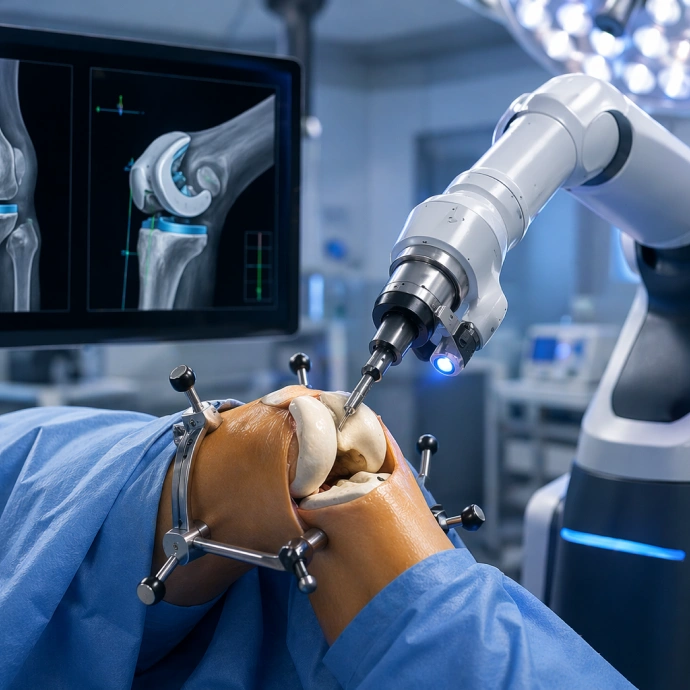
Robotic assistance removes variability from the cutting process. The surgical plan is locked in — either based on a pre-operative CT scan (most systems) or live intraoperative imaging (RoboLens FT3D). When the surgeon makes the cuts, the robotic arm or guidance system keeps the instruments within a pre-defined boundary. The implant ends up where the plan says it should, not where the guide ended up after six adjustments.
With RoboLens FT3D specifically, there’s no pre-op CT scan. The system maps the knee in real-time during surgery using fluoroscopic tracking — which means the planning and execution happen simultaneously, with live data rather than a scan taken days before. This is important in deformed knees where pre-operative imaging often underestimates the correction needed.
The measurable differences between robotic and traditional surgery include: significantly lower rates of implant malpositioning, reduced blood loss during surgery (less soft tissue disruption), faster return to walking and stair climbing, and longer projected implant survival in studies with 5–10 year follow-up data. The last point matters most for patients in their 50s who need the implant to last 25 years.
Where the Difference Is Smallest
For elderly patients with simple, well-aligned arthritis and a short life expectancy for the implant, the precision advantage of robotic surgery matters less. A 75-year-old who needs 10–12 years from their knee replacement will do well with either approach in experienced hands.
The robotic advantage is also less pronounced when the surgeon has extremely high case volumes with traditional technique. Very experienced traditional surgeons in high-volume centres get good alignment results consistently. The gap between robotic and traditional narrows with surgeon experience — it doesn’t disappear, but it narrows.
The Patient Experience: Is It Actually Different?
Honestly — in the immediate post-operative period, robotic surgery patients tend to have less pain and get up faster. That’s the reduced soft tissue disruption at work. Most RoboLens FT3D patients walk the same day as surgery and climb stairs on day 2. Traditional patients often manage this too, but the timeline is slightly longer on average.
At 6 months, the difference narrows. At 1–2 years, both groups reach similar functional outcomes in most studies. The real difference shows up at 10–15 years — in implant survival data, in revision rates, and in how the knee feels at the end of a long day of walking. Those are harder to measure in the short term, but the alignment data predicts them clearly.
Should You Ask for Robotic Surgery?
If you’re under 65, active, and want this knee to last as long as possible — yes, ask specifically about it. If you’re weighing options in Chandigarh or Mohali, Dr TS Gill performs RoboLens FT3D at Max Hospital Mohali and can assess whether the robotic approach is the right choice for your specific anatomy and goals.
The consultation is a straightforward conversation with X-ray review. Book it before you commit to anything.