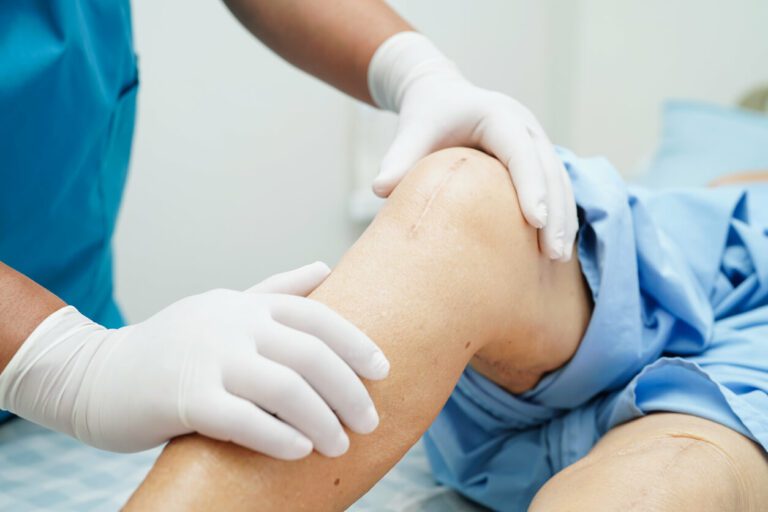
The title “founder” of a surgical technique carries a specific meaning — not someone who adopted and adapted an existing system, but someone who developed an approach from its clinical rationale through its technical execution and validated it in practice. FT3D knee resurfacing is Dr TS Gill’s work in that precise sense.
Background and Training
Dr Tarandeep Singh Gill completed his MS in Orthopaedics and then fellowship training in Germany, where he was exposed to high-volume joint replacement surgery and early robotic assistance systems. He has been practising in the Chandigarh tricity since 2004 and is currently based at Max Super Speciality Hospital, Phase 6, Mohali.
Over more than two decades, he has performed over 5,000 joint replacement procedures — knees and hips, primary and revision. His subspecialisation is joint replacement and reconstructive surgery, with a specific focus on complex cases: severe deformity, revision after failed previous replacement, and anatomically challenging knees that don’t fit the standard template.
The Development of FT3D
FT3D came from a clinical observation made repeatedly over years of robotic practice: pre-operative CT-based planning is limited by its own timeline. The scan is taken days or weeks before surgery. The plan is built from that snapshot. On the day, the joint presents slightly differently — swelling, position, tissue tension all contribute to a gap between what was planned and what’s actually there.
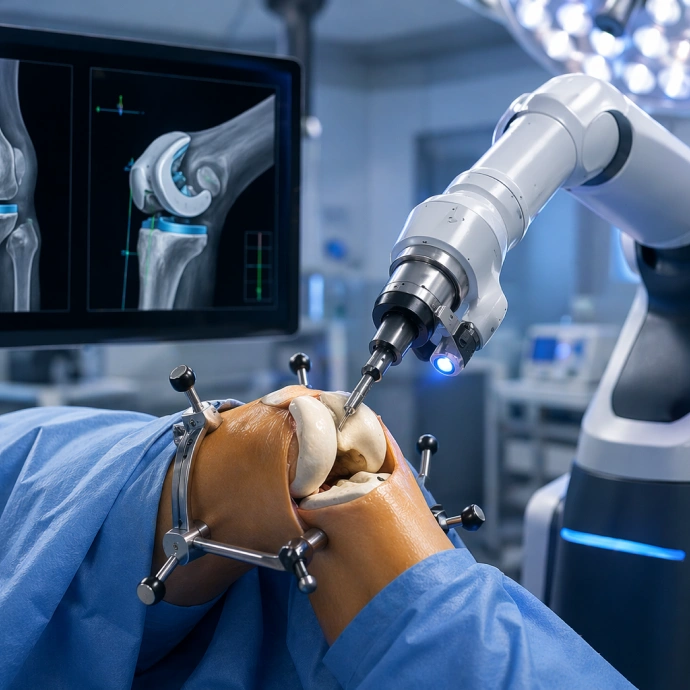
The FT3D system — Fluoroscopy-Tracked Three-Dimensional — eliminates that gap. Fluoroscopic imaging acquired during the procedure itself provides real-time 3D mapping of the joint’s actual geometry. Planning and execution happen simultaneously, with live data. No pre-operative CT scan is required. The procedure adapts to what the surgeon finds, not to what a scan predicted he would find.
This approach is particularly effective for knees with significant deformity. A pre-operative plan for a severe bow-leg might calculate 5 degrees of correction needed. When the surgeon opens and sees the actual deformity, it might need 7 or 8. Real-time imaging captures this; a pre-built CT plan doesn’t adapt to it. This is the practical advantage that drove the development of the technique.
Current Practice
Dr Gill has now performed over 500 FT3D procedures. The technique has been refined through this volume — the kind of incremental adjustment that only comes from case experience and can’t be compressed into a training course. Patients from Delhi, Amritsar, Ludhiana, Jammu, Himachal Pradesh, and further travel to Mohali specifically for this procedure.
He maintains a direct consultation practice — patients see the surgeon who performs their procedure, not a resident or registrar who relays information. The consultation includes X-ray review, clinical examination, and a specific discussion of whether FT3D is the right approach for that patient’s knee. Not everyone who comes in is a candidate, and Dr Gill will say so plainly when they’re not.
Book a consultation at Max Super Speciality Hospital, Mohali — call +91-82880 15106 or book at tsgillortho.com/appointment.