Dr Tarandeep Singh Gill — MS Ortho, MCh Ortho
Director – Joint Replacement & Robotic Surgery · RoboLens FT3D Pioneer · Max Super Speciality Hospital, Mohali

A modern knee replacement usually lasts 20 to 25 years, and large registry studies show that roughly 8 in 10 knees are still working well at the 25-year mark. How long yours lasts depends mostly on how accurately the implant is positioned, your weight, your activity level and whether you look after the muscles around the knee. For patients considering Robotic knee surgery Chandigarh, surgical precision is also an important factor when discussing long-term implant performance.
“Doctor, will I need this done again?”
It’s usually the second question, right after “will it hurt?” And it’s a sensible one. Nobody wants to go through surgery, a hospital stay and weeks of physiotherapy only to be told ten years later that it all has to happen again.
The good news is that knee implants today are built to last a long time. The better news is that a good part of the answer is in your hands, and in the hands of the surgeon who places the implant.
How Long Does a Knee Replacement Actually Last?
For most patients, the honest answer is two decades or more. Joint registries in the UK, Australia and Scandinavia have followed hundreds of thousands of knee replacements over many years. Their numbers are fairly consistent: around 90% of total knee replacements are still in place at 15 years, and roughly 80% at 25 years.
So if you have your knee replaced at 65, there’s a very good chance it will see you comfortably into your late eighties.
Partial knee replacements tend to have a somewhat higher revision rate than total knees over the long term. That doesn’t make them a bad choice. It means the decision has to be made carefully, for the right patient.
What Wears Out in a Knee Replacement?
A knee implant has three main parts: a metal component on the end of the thigh bone, a metal tray on the top of the shin bone, and a medical-grade plastic insert that sits between them. The metal rarely fails. The plastic is the part that slowly wears with use, a bit like the tread on a tyre.
Modern highly cross-linked polyethylene wears far more slowly than the plastic used in the 1990s, which is one reason today’s implants are expected to outlast older ones.
The other long-term issue is loosening, where the bond between the implant and the bone weakens over time. When a knee replacement does need to be redone, loosening and wear are the most common reasons, along with infection and instability.
Five Things That Decide How Long Your Knee Will Last
1. How precisely the implant is placed
This is the one most patients don’t think about, and it matters a great deal. An implant that is even slightly out of alignment carries load unevenly. One side of the plastic wears faster, and the stress on the bone underneath increases.
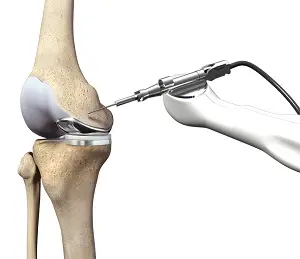
That’s the main reason Dr TS Gill uses robotic knee replacement with RoboLens FT3D. The system maps your knee in 3D during surgery and guides cuts to within a fraction of a millimetre, so the implant sits in the alignment that suits your leg and loads evenly. This is an important aspect of Robotic knee surgery Chandigarh, where advanced technology assists the surgeon with individualised surgical planning. You can read how this compares with the conventional approach in our article on robotic vs traditional knee replacement.
The precision-focused approach used in RoboLens knee surgery also supports personalised assessment of the knee’s structure and alignment.
2. Your body weight
Every extra kilo you carry puts several kilos of extra force through the knee when you walk, and more on stairs. Patients who manage their weight after surgery generally give their implant an easier life.
3. What you ask your knee to do
Walking, cycling, swimming, golf and dancing are all excellent. Long-distance running, jumping sports and heavy squatting under load put repeated high impact through the joint. Most surgeons advise against them, not because they will break the knee straight away, but because they speed up wear over the years.
4. Your age at surgery
Younger, more active patients simply use their knees more, for more years. A 55-year-old is more likely to need a revision in their lifetime than a 75-year-old, purely because the implant has to work for longer. That’s not a reason to keep suffering in your fifties. It’s a reason to choose your surgeon and technique carefully. Our page on RoboLens FT3D explains why bone-preserving resurfacing is often discussed with younger patients.
5. Muscle strength and follow-up
Strong thigh muscles act as shock absorbers for your new knee. Patients who keep up their exercises after the first few months tend to have more stable, more comfortable knees. Regular check-ups also help: an X-ray every few years can pick up early wear or loosening long before you feel anything.
Signs Your Knee Replacement May Need Attention
Most people never need a second operation. But see your surgeon if you notice any of these, even years after surgery:
- New pain in a knee that had been comfortable for years
- Swelling that keeps coming back
- A feeling that the knee is giving way or wobbling
- Warmth, redness or fever, which can point to infection and needs urgent review
- Stiffness that’s getting steadily worse
When a replacement does need to be redone, it’s called revision surgery. It’s more complex than the first operation, but results are generally good in experienced hands. We cover it in detail in revision knee replacement in Chandigarh.
Should You Wait Longer So Your Knee Lasts Longer?
We hear this a lot. “I’ll wait till I’m older, so I only need one operation.”
It sounds logical, but it often backfires. Years of limping weaken the muscles, stiffen the joint and can bend the leg out of shape, which makes the eventual surgery harder and the recovery slower. Meanwhile you lose years of walking, travelling and sleeping comfortably.
The better question isn’t “how old should I be?” It’s “how much is this knee limiting my life?” If the answer is “a lot”, it’s worth a proper conversation. Our article on why people keep delaying knee replacement goes into this honestly.
For patients exploring Robotic knee surgery Chandigarh, an early consultation can help determine whether robotic-assisted replacement or another treatment approach is appropriate.
Frequently Asked Questions
Can a knee replacement last a lifetime?
For many patients, yes. If you have surgery in your mid-sixties or later, a well-placed modern implant has a high chance of lasting the rest of your life.
Does robotic knee replacement last longer?
Robotic surgery improves the accuracy of implant positioning and alignment, which is one of the factors linked to long-term implant survival. Very long-term data on newer robotic systems is still being collected, but better alignment is the reason surgeons expect good durability.
Can I play sports after knee replacement?
Low-impact activities like walking, cycling, swimming, golf and doubles tennis are encouraged. High-impact sports like running and jumping are generally discouraged because they speed up wear.
How will I know if my knee replacement is wearing out?
Wear usually shows up slowly as new pain, recurring swelling or a sense of instability. Regular follow-up X-rays can spot changes before symptoms appear.
Is a second knee replacement as successful as the first?
Revision surgery is more complex and recovery can take longer, but most patients get good pain relief and function back when it’s done by an experienced joint replacement surgeon.
If you’re weighing up knee replacement and want to know how long it’s likely to last in your case, Dr TS Gill sees patients at Max Super Speciality Hospital, Mohali. You can book a consultation here and come with your X-rays and questions. Patients interested in RoboLens knee surgery can also discuss the available treatment options and suitability during their consultation.