FT3D knee resurfacing exists because one orthopaedic surgeon in Chandigarh refused to accept that a pre-operative CT scan was the best way to guide a robotic knee procedure. That surgeon is Dr Tarandeep Singh Gill — and the technique he helped develop is now the most precise robotic knee resurfacing system available in North India.
This article explains where the idea came from, what problem it was solving, how the technology was built, and why being treated by the person who invented the technique matters clinically — not just as a marketing point.
The Problem With Pre-Operative Imaging
Every major robotic knee system before FT3D shared the same fundamental workflow: the patient gets a CT scan weeks before surgery, that scan is used to build a 3D model of the knee, and on the day of surgery, the robot references that pre-built model to guide the surgeon’s cuts.
On paper, this sounds rigorous. In practice, it has a significant flaw: the knee that arrives on the operating table is not the same knee that was scanned weeks earlier.
Between the CT scan and the operation date, several things change:
- Soft tissue tension varies with the patient’s position, anaesthesia, and relaxation state
- The joint space shifts as the patient moves between appointments
- Fluid levels in the joint fluctuate day to day
- The physical relationship between bones changes when the patient is lying flat under general anaesthesia versus standing upright during a scan
Pre-operative imaging captures one moment in the life of a joint. Surgery happens at a completely different moment. The model being used to guide the robot is already outdated by the time the procedure begins.
Dr TS Gill identified this gap early in his career working with robotic systems. His question was straightforward: why not map the knee during the operation, when we can see exactly what we are working with?
The Development of Real-Time 3D Mapping
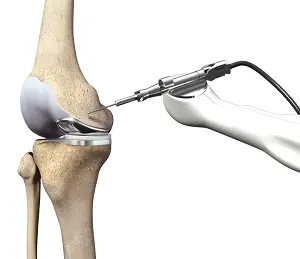
The answer to that question became the foundation of the FT3D system. Rather than relying on pre-operative CT data, FT3D uses intraoperative mapping — the robotic system builds its 3D model of the knee in real time, on the operating table, using probe-based surface registration and live positional tracking.
The name FT3D reflects this principle: Functional Tissue, Three-Dimensional. The “functional” component refers to the fact that the mapping captures tissue in its actual surgical state — not a pre-operative approximation of it.
The development process involved close collaboration between Dr TS Gill and the engineering team at RoboLens, the company that manufactures the hardware and software platform. Dr Gill’s clinical input was central to how the intraoperative registration process was designed, refined, and validated across real surgical cases before reaching the accuracy levels that now define the FT3D generation.
What Makes FT3D Different From Earlier Robotic Systems
The FT3D generation is the most advanced evolution of the RoboLens platform. Earlier generations still incorporated elements of pre-operative planning. The FT3D breakthrough was achieving intraoperative mapping accurate enough to completely replace the CT scan step — eliminating radiation exposure, reducing the pre-surgery workload for the patient, and producing a more accurate map than any pre-operative scan could provide.
Key technical improvements in the FT3D generation include:
- Sub-millimetre registration accuracy through surface probe mapping of bone landmarks during surgery
- Live soft tissue tension tracking that accounts for how the knee actually behaves under surgical conditions
- Dynamic implant positioning adjustable intraoperatively based on real-time measurements
- No CT scan required — eliminating radiation exposure, extra cost, and planning delays for the patient
Why the Inventor Is the Right Surgeon for Your FT3D Procedure
This is not simply a prestige point. There is a direct clinical reason why being operated on by Dr TS Gill carries a specific advantage with FT3D that no other surgeon can replicate.
Dr Gill understands the system’s design decisions — not just how to use it, but why it was built the way it was. When an intraoperative reading is unusual, or when the system’s output needs to be interpreted alongside clinical observation, the surgeon who helped shape the system’s logic is in a fundamentally different position than a surgeon who learned to use it from a training manual.
This matters most in complex cases: revision procedures, knees with significant deformity, younger patients with unusual anatomy, or cases where the standard protocol does not fit the patient’s presentation. In these situations, the depth of knowledge that comes from being involved in the technology’s development translates directly into better surgical decision-making.
No other surgeon in North India has been involved in the development of FT3D. Dr TS Gill is currently the only practitioner in the region performing this procedure.
The Clinical Goal: Preserve More, Replace Less
The entire development effort behind FT3D was aimed at one outcome: preserving more of the patient’s natural knee while achieving better mechanical alignment than conventional or earlier robotic systems.
Traditional total knee replacement removes all three compartments of the knee joint and replaces them with metal and plastic implants. For patients with arthritis limited to one or two compartments, this means removing healthy bone and tissue unnecessarily.
FT3D knee resurfacing addresses only the damaged compartment. The healthy tissue is preserved. The natural knee mechanics are maintained to a greater degree. Recovery is typically faster, and the patient retains more of their biological joint.
The accuracy of real-time 3D mapping is what makes selective resurfacing reliably reproducible at scale. Without precise intraoperative data, surgeons could not confidently operate at the compartment level. FT3D solved that precision problem — and that is why the technique exists in the form it does today.
Where to Get FT3D Knee Resurfacing in North India
RoboLens FT3D knee resurfacing is performed by Dr TS Gill at Max Super Speciality Hospital, Mohali, serving patients from Chandigarh, Punjab, Haryana, Himachal Pradesh, Delhi, Jammu & Kashmir, and beyond. It is the only centre in North India where this procedure is currently available.
Patients can book an initial consultation to assess whether they are suitable candidates. Most assessments are completed in a single visit with an X-ray and clinical examination. No CT scan is required at any stage.
→ Complete guide to RoboLens FT3D Knee Resurfacing
→ Book a Consultation with Dr TS Gill
Frequently Asked Questions
Who invented FT3D knee resurfacing?
FT3D knee resurfacing was developed with the direct clinical involvement of Dr Tarandeep Singh Gill, an orthopaedic surgeon based in Chandigarh, India. Dr Gill’s input shaped the intraoperative mapping workflow and the real-time 3D registration process that defines the FT3D generation of the RoboLens system.
Is FT3D the same as RoboLens?
RoboLens is the name of the hardware and software platform. FT3D refers specifically to the generation of that system which achieves full intraoperative mapping without any pre-operative CT scan. When people refer to “FT3D knee resurfacing,” they mean a procedure performed using the RoboLens FT3D system.
Where is FT3D knee resurfacing available in India?
As of 2026, Dr TS Gill at Max Super Speciality Hospital, Mohali (Chandigarh region) is the only surgeon in North India performing knee resurfacing with the RoboLens FT3D system.
How is FT3D different from MAKO robotic surgery?
MAKO (Stryker) requires a CT scan before surgery and builds its plan from pre-operative data. FT3D creates its complete 3D map during the operation. This produces a more accurate, current picture of the knee under actual surgical conditions and eliminates the CT scan entirely.
What is the cost of FT3D knee resurfacing in Chandigarh?
FT3D knee resurfacing typically costs between ₹2 lakh and ₹3.5 lakh depending on the extent of resurfacing required and the implant selected. This is generally less than total knee replacement because it is a targeted, partial procedure. Dr TS Gill provides a complete cost breakdown at the initial consultation.