Dr Tarandeep Singh Gill — MS Ortho, MCh Ortho
Director – Joint Replacement & Robotic Surgery · RoboLens FT3D Pioneer · Max Super Speciality Hospital, Mohali
The FT3D technique didn’t come from a manufacturer. It was developed by Dr TS Gill through years of observing the gap between what pre-operative CT plans predicted and what he actually found when he opened a deformed knee. That gap — sometimes small, sometimes clinically significant — was the problem he set out to solve.
The Problem That Started It
Robotic knee surgery using CT-based planning had already been established in India by the time Dr Gill began working with the technology. The results were good — clearly better than conventional technique in most series. But there was a pattern. In knees with significant deformity, the pre-built plan sometimes underestimated the correction required. The robot executed the plan precisely. The plan was off.
The issue is fundamental to any pre-operative planning system: a scan taken lying down in a CT machine, days before surgery, doesn’t perfectly capture what the knee looks like when it’s open on the table, with soft tissue tension, position, and the surgeon’s direct visual assessment all in play. The correction needed is calculated without those variables. Sometimes the calculation is spot on. Sometimes it isn’t.
The FT3D Solution: Intraoperative Planning
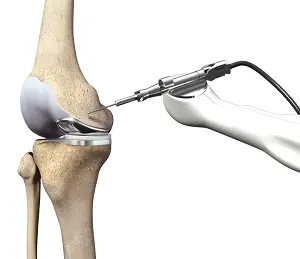
Dr Gill’s approach was to shift the planning from before surgery to during surgery. Using fluoroscopic imaging — a form of live X-ray — acquired during the procedure itself, the system builds its 3D model of the joint in real time, as the operation is happening. The planning and the surgery happen simultaneously, with current data, not a prediction from days ago.
FT3D stands for Fluoroscopy-Tracked Three-Dimensional. The name describes the mechanism: fluoroscopic tracking, used to build a three-dimensional map of the joint, updated live throughout the procedure. The surgeon sees exactly where each cut needs to go and confirms the plan before executing — not after a separate planning session that happened offline.
Fellowship Training and Clinical Foundation
Dr Gill’s foundation was built during fellowship training in Germany — where he was exposed to both conventional high-volume joint replacement and early robotic systems. He has practised in the Chandigarh tricity since 2004, accumulating over 5,000 joint replacement procedures. The FT3D technique was developed and refined through this clinical volume.
The decision to not require a pre-operative CT scan was partly clinical and partly practical. Clinical: real-time data is more accurate than pre-operative prediction. Practical: in a patient population spread across Punjab, Haryana, Himachal Pradesh, and Jammu, requiring a CT scan weeks before surgery adds a significant logistical barrier, particularly for patients from smaller cities where quality CT scanning may not be readily available. Removing that barrier was built into the technique from the start.
Where FT3D Is Available
RoboLens FT3D is currently available only through Dr Gill at Max Super Speciality Hospital, Mohali. He is the only surgeon in North India who performs this technique. Patients travel from across the region — Delhi, Ludhiana, Amritsar, Jammu, Shimla — to access it. The concentration of experience in one centre is intentional: technique refinement comes from volume, and splitting across multiple sites dilutes that.
If you’d like to understand whether FT3D resurfacing is appropriate for your specific knee, a consultation is the starting point. X-ray review, clinical examination, and a direct conversation about the options. Book at tsgillortho.com/appointment or call +91-82880 15106.