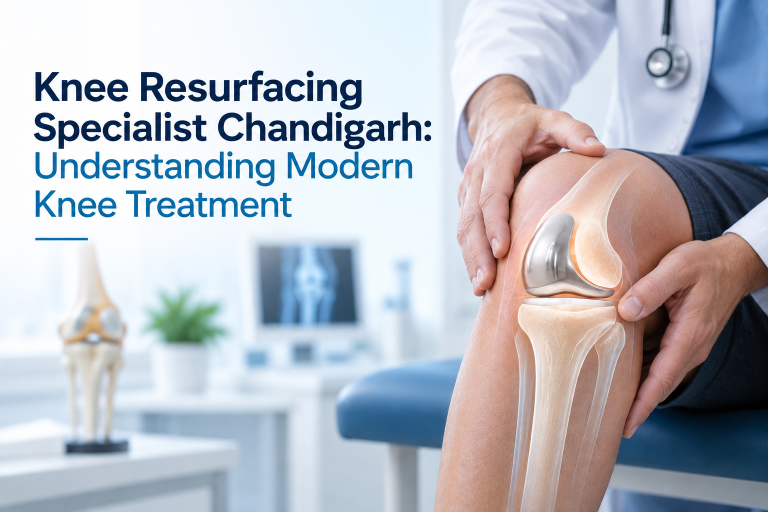
Most people searching for knee surgery in Chandigarh end up comparing hospitals, robot brands, and cost estimates. Very few explain what FT 3D knee resurfacing actually is — and how it’s different from the robotic surgery you’ve probably read about elsewhere.
This article covers the technique in plain language. No brochure language. Just what the procedure involves, who it’s designed for, and what you can realistically expect.
What Is FT 3D Knee Resurfacing?
FT 3D stands for Fluoroscopy-Tracked Three-Dimensional knee resurfacing. The “fluoroscopy-tracked” part is what makes it different from standard robotic systems.
Most robotic knee surgery platforms — MAKO, Navio, and others — require a CT scan taken days before your operation. That scan creates a 3D model of your knee, which the robot uses during surgery to guide bone cuts. The problem: your knee’s actual position during surgery is never exactly the same as when you were lying in a scanner a week earlier.
FT 3D takes a different approach. Instead of pre-op imaging, the system creates a real-time fluoroscopic 3D map of your knee while you’re on the operating table — actual anatomy, actual position, actual moment. The bone cuts are then guided by live data rather than a scan taken under different conditions.
In simple terms: Standard robotic surgery plans from a picture taken last week. FT 3D plans from what your knee actually looks like right now, on the table.
Dr TS Gill, Director of Orthopaedics at Max Super Speciality Hospital, Mohali, was involved in the clinical development of this technique and is currently the only surgeon in North India performing it through the RoboLens FT3D platform.
FT 3D vs Standard Robotic Knee Surgery — Key Differences
| Feature | Standard Robotic Surgery | FT 3D (RoboLens) |
|---|---|---|
| Imaging required before surgery | CT scan (radiation, cost) | No pre-op CT scan |
| Data used during surgery | Pre-op scan from days earlier | Real-time fluoroscopic imaging |
| Accuracy | High | Higher — based on live anatomy |
| Bone preservation | Depends on system | Only damaged cartilage/bone removed |
| ICU stay typically required | Often yes | No — general ward only |
| Walking after surgery | 1–3 days | 3–4 hours in most cases |
| Hospital stay | 3–5 days average | 2–3 days average |
Who Is FT 3D Knee Resurfacing For?
Not every knee condition requires full knee replacement. FT 3D resurfacing is particularly useful for patients whose damage is limited to one or two compartments of the knee — meaning healthy cartilage and bone elsewhere can be preserved.
You may be a candidate if:
- You have moderate to severe knee arthritis in one or more compartments
- You are between 50 and 75 years old (though age alone is not a disqualifier)
- Non-surgical treatments (physiotherapy, injections, medications) have stopped working
- Your pain is significantly affecting daily activity — climbing stairs, walking distances, sleeping
- X-rays or MRI confirm bone-on-bone wear in affected compartments
Younger patients (40s) are increasingly choosing FT 3D resurfacing specifically because it preserves more native bone — making any future revision surgery easier if needed decades later.
If you’re unsure whether your knee qualifies, Dr TS Gill offers a preliminary X-ray review via WhatsApp. Send your scans to +91-82880 15106 for an initial opinion before committing to a consultation.
FT 3D Knee Resurfacing in Chandigarh — Where It’s Performed
The procedure is performed at Max Super Speciality Hospital, Phase 6 (Sector 56), Mohali — approximately 10–15 minutes from central Chandigarh via Madhya Marg. For Chandigarh patients, this is a more practical option than many assume: the drive from Sector 17 or Sector 22 is comparable to crossing the city, and Max Mohali has the advantage of being a dedicated tertiary care centre rather than a general hospital with an orthopaedic wing.
The RoboLens FT3D system is installed at Max Mohali. It is not available at any other hospital in the region, which is why patients travel from across Punjab, Haryana, Himachal Pradesh, and even Delhi specifically for this procedure.
For Chandigarh patients considering robotic knee replacement, Max Mohali is the closest facility offering this specific technology.
What the Procedure Involves — Step by Step
Before Surgery
No CT scan is required. You’ll need standard pre-operative blood work and an X-ray to confirm the extent of joint damage. A consultation with Dr TS Gill typically takes 30–45 minutes including review of your imaging. Most patients are cleared for surgery within a week of consultation.
During Surgery
The operation takes approximately 60–90 minutes under spinal anaesthesia in most cases. The RoboLens FT3D system creates a real-time fluoroscopic 3D map of the joint as the first step. Using this live data, bone preparation and implant positioning are guided with sub-millimetre precision. Only the damaged compartment(s) are resurfaced — healthy tissue remains untouched.
After Surgery
Most patients are walking with support 3–4 hours after the procedure. This is one of the most common things patients find surprising. The absence of general anaesthesia and the minimal soft-tissue disruption compared to traditional surgery means recovery begins almost immediately.
Hospital stay is typically 2–3 days. Physiotherapy starts on day one. Most patients return to light activity within 2–3 weeks and to full normal activity within 6–8 weeks.
Cost of FT 3D Knee Resurfacing in Chandigarh
The procedure costs between ₹2 lakh and ₹3.5 lakh per knee at Max Hospital Mohali, depending on whether partial or total resurfacing is performed and the implant selected. This is inclusive of surgeon fees, operating theatre charges, implant cost, and standard hospital stay.
Chandigarh-registered health insurance — including government employee schemes, CGHS, and private plans — is accepted at Max Mohali. Most major empanelments cover robotic knee surgery under their surgical benefit. The billing team can confirm coverage before you commit.
Why Patients From Chandigarh Choose Dr TS Gill
The honest reason most patients cite is specificity. Dr TS Gill does one thing — joint replacement and resurfacing — and has performed over 5,000 procedures. The RoboLens FT3D system is not available at hospitals that offer it as one of twenty surgical services. Max Mohali’s orthopaedic setup is built around high-volume joint replacement, which means the anaesthesia team, physiotherapy team, and post-op nursing are all experienced with this specific recovery pathway.
The 3,000th RoboLens surgery milestone — covered by national media including The Wire — reflects a volume that most robotic surgery centres in North India haven’t reached with any platform.
Find Out If FT 3D Is Right for Your Knee
Send your X-rays or MRI to Dr TS Gill for a preliminary assessment. No commitment required — just an honest opinion on whether FT 3D resurfacing is appropriate for your condition.
Book a Consultation