Dr Tarandeep Singh Gill — MS Ortho, MCh Ortho
Director – Joint Replacement & Robotic Surgery · RoboLens FT3D Pioneer · Max Super Speciality Hospital, Mohali
Shoulder surgery is often sought later than it should be. Patients manage shoulder pain for months — sometimes years — with painkillers and avoidance of activities, before finding out that the underlying problem has a specific treatment that gets better results when addressed earlier. Here is what shoulder surgery in Chandigarh involves and when it’s actually the right option.
The Most Common Conditions Requiring Shoulder Surgery
Rotator cuff tears are the most frequent reason for shoulder surgery in patients over 50. The rotator cuff is a group of four muscles and tendons that hold the shoulder joint together and control arm movement. Tears develop gradually (degenerative tears in older patients) or acutely (trauma, falls). A partial tear can sometimes be managed non-surgically; a full-thickness tear, particularly in an active patient, usually needs repair to regain full strength.
Recurrent shoulder dislocation — where the shoulder keeps popping out with minimal provocation — is a mechanical problem that physiotherapy alone can’t fix. The labrum (the cartilage ring that provides stability to the shoulder socket) is typically torn. Arthroscopic Bankart repair addresses this directly, restoring the structural stability that prevents re-dislocation.
Shoulder impingement with chronic bursitis — where the bursa (fluid sac) between the rotator cuff and the shoulder bone becomes chronically inflamed — is a condition where arthroscopic subacromial decompression (creating more space in the shoulder by shaving down a bony prominence) can provide lasting relief when injections and physiotherapy haven’t.
SLAP tears — damage to the superior labrum of the shoulder joint — occur in throwing athletes, swimmers, and patients who have had a specific type of shoulder trauma. Arthroscopic repair is the treatment for tears that don’t respond to conservative management.
Arthroscopic vs Open Shoulder Surgery
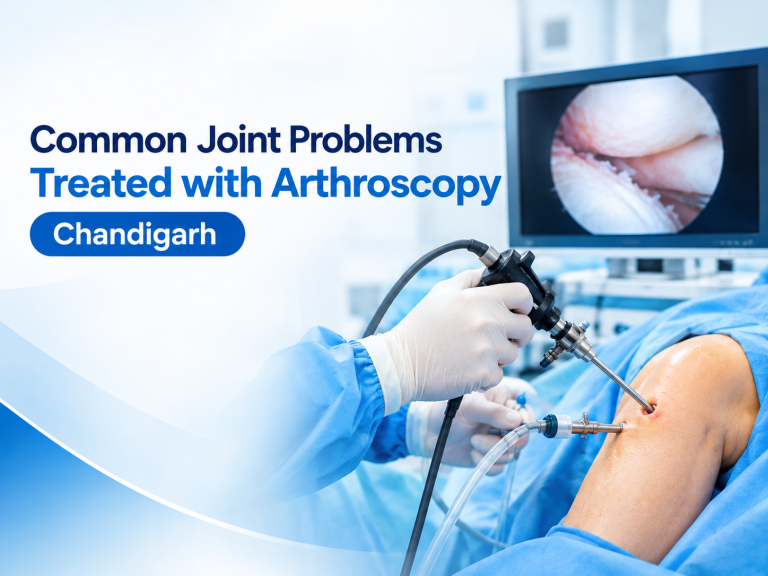
Most shoulder procedures are now done arthroscopically — through small portals rather than a large incision. The camera and instruments go through 3–4 small openings around the shoulder. Recovery is faster, post-operative pain is less, and the risk of infection and stiffness is lower than with open surgery.
Open surgery is still used for some cases — very large rotator cuff tears, complex reconstructions, and shoulder replacement. But for the majority of common shoulder conditions, arthroscopy at a well-equipped centre in Chandigarh or Mohali is the appropriate first surgical approach.
Recovery After Shoulder Surgery
Recovery timelines vary based on the procedure. Arthroscopic subacromial decompression: 2–4 weeks to return to desk work, 6–8 weeks to return to light activity. Rotator cuff repair: 3 months in a sling for large tears, physiotherapy starting early, return to overhead activity at 4–6 months. Bankart repair: 3 weeks in a sling, return to sports at 4–6 months.
Physiotherapy is not optional in shoulder surgery recovery — it’s the mechanism by which strength and range of motion return. Patients who skip or rush the physio phase consistently have worse outcomes than those who follow the protocol. The surgery repairs the structure; the physiotherapy recovers the function.
Dr TS Gill performs shoulder arthroscopy at Max Super Speciality Hospital, Mohali. If you have persistent shoulder pain that hasn’t responded to conservative management, an assessment including MRI will clarify what’s causing it and whether surgery is the right next step. Book at tsgillortho.com/appointment or call +91-82880 15106.