Dr Tarandeep Singh Gill — MS Ortho, MCh Ortho
Director – Joint Replacement & Robotic Surgery · RoboLens FT3D Pioneer · Max Super Speciality Hospital, Mohali
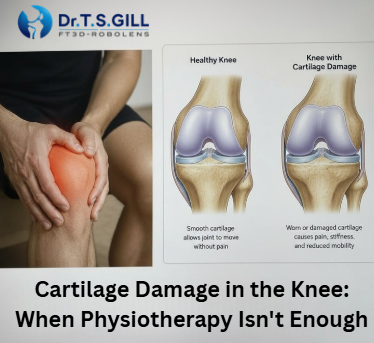
Cartilage Damage in the Knee has one significant problem: it doesn’t heal well. Unlike muscle or bone, cartilage has almost no blood supply in most areas — which means damage doesn’t repair itself the way other tissues do. A cartilage defect that isn’t addressed tends to grow. And the symptoms — aching, swelling after activity, a knee that feels sore the morning after exercise — can be easy to dismiss until the damage is significant.
Types of Cartilage Damage
Not all cartilage problems are the same. The two main categories:
Focal cartilage defects: A discrete area of cartilage damage — often from injury, a previous meniscus problem, or a single traumatic event. The surrounding cartilage may be relatively healthy. These are the cases where cartilage preservation techniques (microfracture, OATS, ACI) are most relevant. They’re most appropriate in younger patients (under 50) with an isolated defect on a weight-bearing surface.
Generalized cartilage loss (osteoarthritis): Diffuse wear across a compartment or the whole joint. Cartilage restoration doesn’t work well here — the field is too wide and the biology too compromised. This is where partial or total joint replacement enters the picture.
Non-Surgical Management
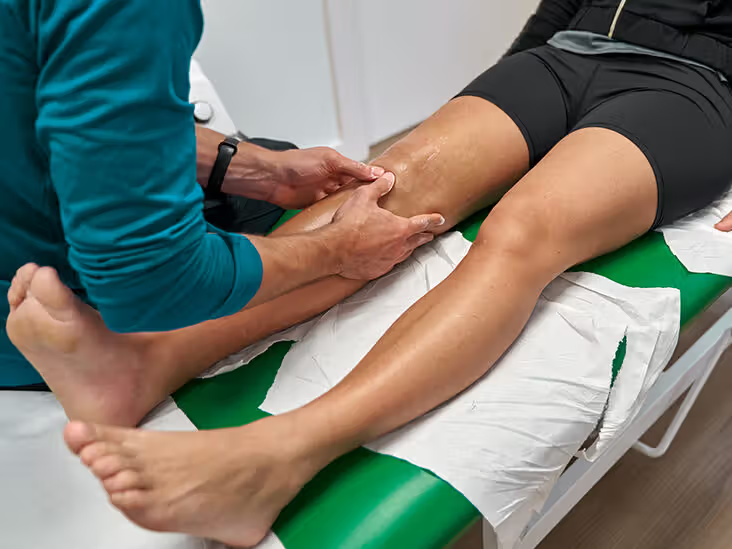
For early-stage cartilage wear: physiotherapy to strengthen the muscles around the joint and reduce load on the damaged area, weight management, activity modification, and anti-inflammatory medication. PRP (Platelet-Rich Plasma) injections have some evidence for symptom relief in early cartilage damage — they don’t regenerate cartilage but can reduce pain and improve function for months at a time.
Surgical Options for Focal Defects
Microfracture: Small holes drilled into the exposed bone to stimulate a healing response. Creates fibrocartilage rather than true hyaline cartilage — good for small defects, less durable over time for larger ones.
OATS (Osteochondral Autologous Transfer): Plugs of cartilage and bone taken from a non-load-bearing area of the knee and transplanted into the defect. Better quality cartilage than microfracture, but limited by the size of defect that can be addressed.
Partial knee resurfacing (FT3D): When a compartment of the knee is involved but the rest of the joint is healthy, partial resurfacing — as in Dr. TS Gill’s FT-3D knee resurfacing Chandigarh techniques — addresses the damaged area while preserving everything else. The recovery is faster than total replacement and the feel of the knee post-surgery is more natural.
If you’re in Chandigarh or Mohali with knee pain that you suspect is cartilage-related, a consultation with Dr. TS Gill will clarify what’s damaged and what treatment approach makes sense at your stage.