
Dr Tarandeep Singh Gill — MS Ortho, MCh Ortho
Director – Joint Replacement & Robotic Surgery · RoboLens FT3D Pioneer · Max Super Speciality Hospital, Mohali
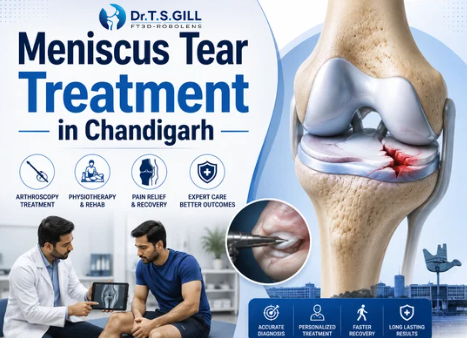
The meniscus is one of those structures that most people haven’t thought about until it’s giving them trouble. It’s a C-shaped cartilage pad that sits between the femur and tibia in the knee — essentially a shock absorber and stabilizer. When it tears, the symptoms can range from mild aching to a knee that locks or gives way completely. The treatment depends almost entirely on the type and location of the tear. If you are looking for Meniscus Tear Treatment in Chandigarh, understanding the type of meniscus injury and available treatment options is an important first step toward choosing the right care.
Not All Meniscus Tears Are the Same
This is the part most online searches don’t adequately explain. A tear in the outer third of the meniscus (the “red zone”) has a blood supply and can sometimes heal on its own or with surgical repair. A tear in the inner two-thirds (the “white zone”) has no blood supply and won’t heal — if it’s symptomatic, the damaged tissue usually needs to be removed (partial meniscectomy) or repaired with sutures under arthroscopy.
Degenerative tears — which happen as the meniscus wears over years, common in patients over 45 — behave differently from acute traumatic tears in younger patients. A degenerative tear in someone with early arthritis often responds well to physiotherapy and doesn’t always need surgery. The same type of tear in a 28-year-old athlete usually does.
When Conservative Treatment Works
For smaller tears, partial thickness tears, and degenerative tears in older patients: physiotherapy focused on quadriceps and hamstring strengthening, combined with activity modification and anti-inflammatory medication, often resolves symptoms adequately. This is a legitimate first-line approach and shouldn’t be dismissed as “not doing anything.”
The benchmark is usually 6–8 weeks. If pain and swelling haven’t improved meaningfully in that period, or if the knee continues to lock or give way, surgical assessment is the next step.
Arthroscopic Meniscus Surgery — What It Involves
For patients considering Arthroscopy Chandigarh, Arthroscopic meniscus surgery in Chandigarh is a day-procedure in most cases. Small incisions, a camera inside the joint, and either trimming the damaged tissue (partial meniscectomy) or repairing it with sutures (meniscus repair). Meniscectomy has faster recovery — most patients are walking comfortably within a week. Meniscus repair requires a longer protected recovery (4–6 weeks on crutches) but preserves more tissue, which matters long-term.
The decision between repair and removal depends on tear type, location, size, and the patient’s age and activity goals. A 35-year-old who wants to run marathons gets a different recommendation than a 60-year-old with moderate activity expectations.
The Longer-Term Picture
Meniscus tissue acts as a protective layer for the cartilage underneath. Removing too much of it accelerates cartilage wear — which is why surgeons try to preserve as much meniscus as possible. A well-done partial meniscectomy removes only what’s causing symptoms. Aggressive removal creates problems 10–15 years down the line.
If you’re dealing with knee pain and have been told (or suspect) it’s a meniscus tear, getting a proper assessment in Chandigarh or Mohali is the right first step. Dr. TS Gill’s practice at Max Hospital covers both acute injuries and degenerative knee conditions — book a consultation here and get clarity on what kind of tear you have and what treatment makes sense.